recursion
Prof. Madonna Lamin

What is recursion?
- Learning recursion yields maintainable, consistent, provably correct code.
Recursion is cool because it’s both simple and
- powerful.
- Basically, it’s a way to solve tough problems by using functions or procedures that refer back to themselves.
So basically, recursion is when a function calls
- itself to solve a problem.
MANY ALGORITHMS TECHNIQUES ARE BASED ON RECURSION
- Dynamic Programming
- Dynamic Programming involves solving complex problems by breaking them down into simpler subproblems and storing their solutions to avoid redundant computations.
- Recursion is often used to solve these subproblems, with techniques like memoization optimizing the process by storing previously computed results.
- Classic examples include the Fibonacci sequence and shortest path problems.
MANY ALGORITHMS TECHNIQUES ARE BASED ON RECURSION
2. Backtracking
- Backtracking is a systematic approach to finding solutions by trying different paths and backtracking when a dead end is reached.
- Recursion is commonly employed in backtracking algorithms to explore all possible solutions through a tree-like structure.
- Problems such as N-Queens, Sudoku, and maze solving are typically tackled using backtracking techniques.
MANY ALGORITHMS TECHNIQUES ARE BASED ON RECURSION
3. Divide and Conquer (Binary Search, Quick Sort, and Merge Sort)
- Divide and Conquer involves breaking down a problem into smaller subproblems, solving them recursively, and combining their solutions.
- Recursion is fundamental to this approach, with algorithms like Binary Search, Quick Sort, and Merge Sort utilizing recursive techniques.
- Binary Search efficiently searches a sorted array by recursively dividing it in half.
- Quick Sort and Merge Sort are recursive sorting algorithms that divide the array and merge sorted subarrays, respectively, to achieve sorting.
MANY ALGORITHMS TECHNIQUES ARE BASED ON RECURSION
- Tree Traversal
- Tree Traversal algorithms systematically visit and process all nodes in a tree data structure.
- Recursion simplifies the implementation of tree traversal algorithms like Depth-First Search (DFS) and Breadth-First Search (BFS).
- DFS explores as far as possible along each branch before backtracking, making it well-suited for recursive implementation.
MANY ALGORITHMS TECHNIQUES ARE BASED ON RECURSION
- Sorting Algorithm
- Various sorting algorithms, such as Quick Sort, Merge Sort, and Heap Sort, utilize recursion to efficiently sort elements.
- Recursion enables these algorithms to divide the array into smaller subarrays recursively until they are individually sorted and then merge them back together.
- Quick Sort, for instance, partitions the array recursively based on a pivot element, while Merge Sort divides the array into halves and merges them in sorted order.
IMPORTANCE OF RECURSION
- Recursion is important because it gives us a clever way to solve problems.
- It breaks down big problems into smaller, more manageable parts, making our code easier to understand.
- We use recursion a lot for problems that have a natural repetitive structure, like sorting or working with trees.
Plus, learning how to think recursively helps us become better
- problem solvers, not just in programming but also in other areas where we need to break down complex problems.
- And in computer science theory, recursion is a big deal because it helps us understand how computers work and how to measure how hard or easy a problem is to solve. So, basically, recursion is a handy tool that helps us solve problems smarter and understand computers better.
WE WILL USE RECURSION IN THIS UNIT TO:
-
Binary Search - Iterative and Recursive Approach
-
Factorial Function
-
Compute Fibonacci Sequence
-
Determine whether a word is palindrome
-
Compute powers of a number
-
Solve the ancient Towers of Hanoi problem.
Factorial Function - ITERATIVE
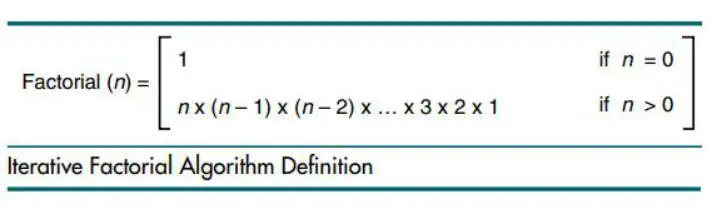
Problem Statement:Given a number X, print its factorial.
To obtain the factorial of a number, it has to be multiplied by all the whole numbers preceding it. More precisely X! = X x (X - 1) x (X - 2)... x 3 x 2 x 1 Note: X is always a positive number.
Example 1:
Input: X = 5 Output: 120 Explanation: 5! = 54321
Example 2:
Input: X = 3 Output: 6 Explanation: 3!=321
Note that this definition is iterative.
- A repetitive algorithm is defined iteratively whenever
- the definition involves only the algorithm parameter(s) and not the algorithm itself.
We can calculate the factorial(4) using:
- factorial(4) = 4 x 3 x 2 x 1 = 24
Factorial - Recursion defined
A repetitive algorithm uses
- recursion whenever the algorithm appears within the definition itself. For example, the factorial
- algorithm can be defined recursively
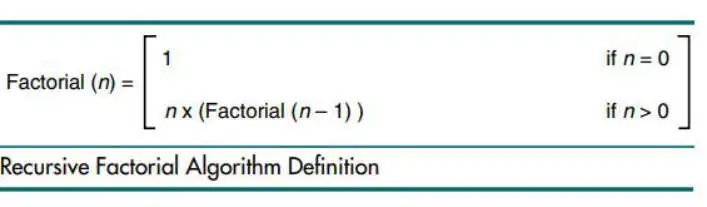
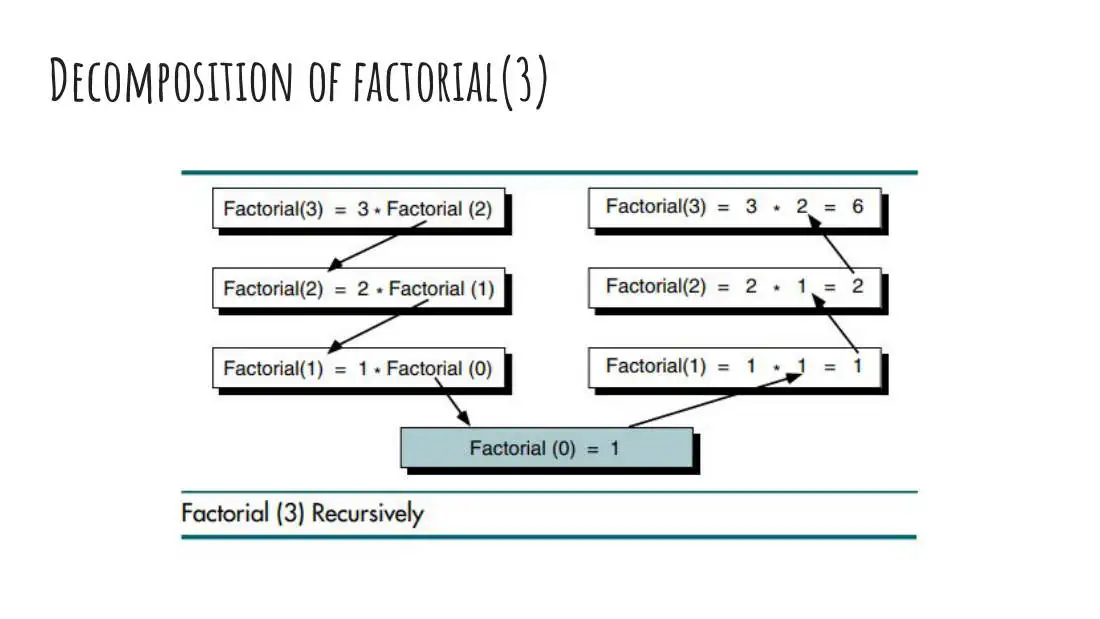
“Recursion is a repetitive process in which algorithm calls itself”
Iterative solution
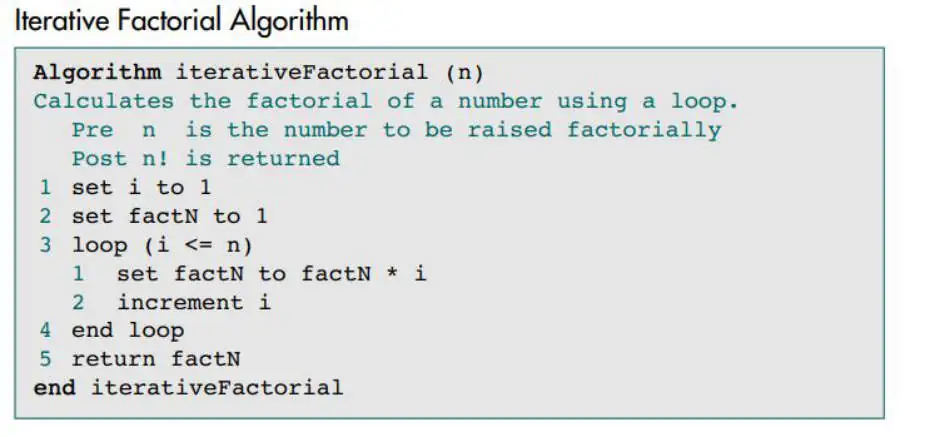
Time Complexity: O(n)
Space Complexity: O(1)
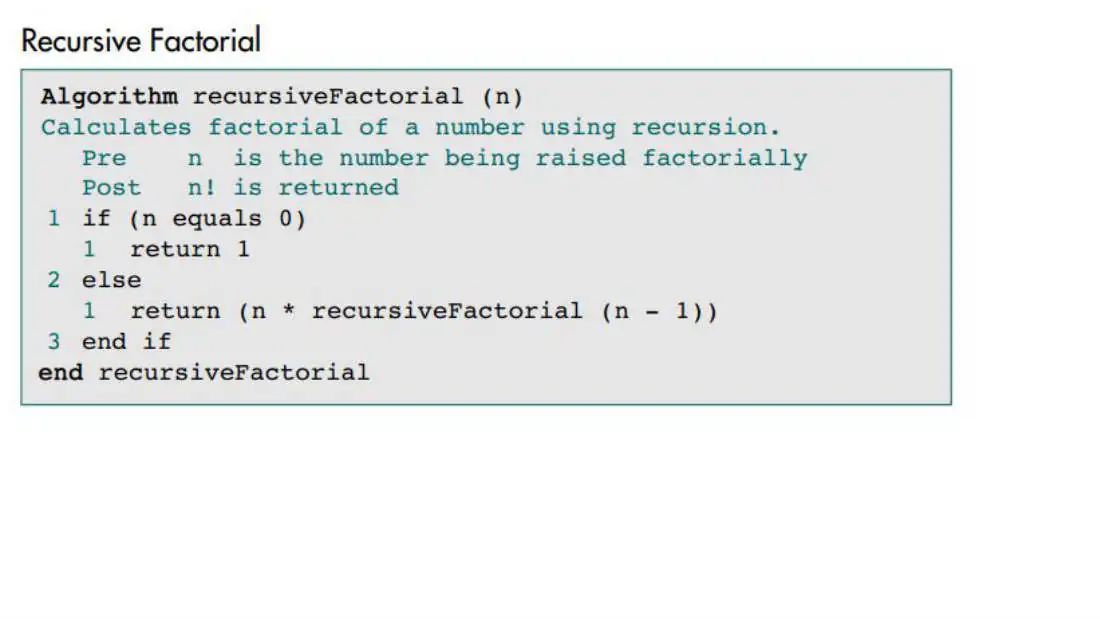
Recursive solution
The recursive solution does not need a loop; recursion is
- itself repetition.
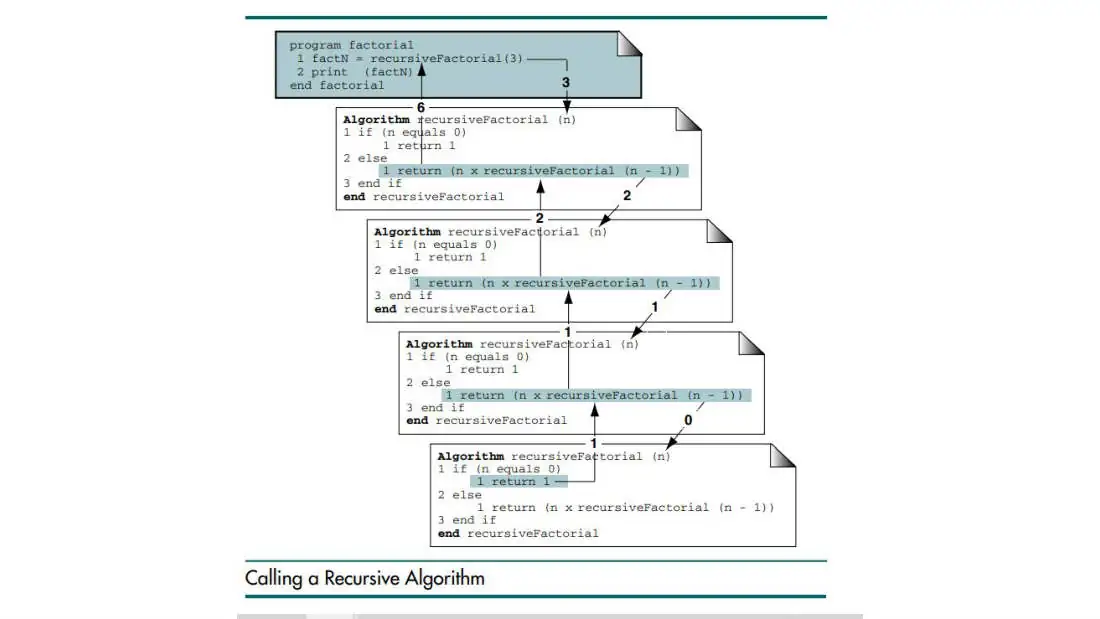
In the recursive solution, we let the factorial algorithm
- call itself, each time with a different set of parameters.
Time Complexity: O(n) since the function is being called n times, and for each function, we have only one printable line that takes O(1)time, so the cumulative time complexity would be O(n)
Space Complexity: O(n), in the worst case, the recursion stack space would be full with all the function calls waiting to get completed and that would make it O(n)
recursion stack space.
- If you compare the iterative and recursive versions of factorial, you should be immediately struck by how much simpler the code is in the recursive version.
- First, there is no loop.
The recursive version consists of a simple
- selection statement that returns either the value 1 or the product of the two values, one of which is a call to a factorial itself.
Limitations of recursion
- Recursion works best when the algorithm uses a data structure that naturally supports recursion.
- For example: Trees are naturally recursive structure and recursion works well with them.
- In other cases, the algorithm is naturally suited to recursion
- For example: The binary search algorithm lends itself to a natural recursive algorithm, as does the Towers of Hanoi algorithm.
- On the other hand, not all looping algorithms can or should be implemented with recursion.
Recursive solutions may involve extensive overhead (both time
- and memory) because they use calls.
- Each call takes time to execute
- A recursive algorithm therefore generally runs more slowly than its non-recursive implementation.
You should NOT use recursion if the answer to any of the following questions is NO:
-
Is the algorithm or data structure suited to recursion?
-
Is the recursive solution shorter and more understandable?
-
Does the recursive solution run within acceptable time and space limits?
- Each time we make a call we use up some of our memory allocation.
- If the recursion is deep - that is, if there are many recursive calls- we may run out of memory.
Because of the the time and memory overhead,
- algorithms such as factorial are better developed iteratively if large numbers are involved.
- As a general rule, recursive algorithms should be used only when their efficiency is logarithmic.
Recursive examples
-
Binary Search
-
Factorial of a number
-
Fibonacci numbers
-
Greatest Common Divisor (GCD)
-
Determine whether a word is palindrome
-
Compute powers of a number
-
Prefix to Postfix conversion
-
Towers of Hanoi
Fibonacci numbers
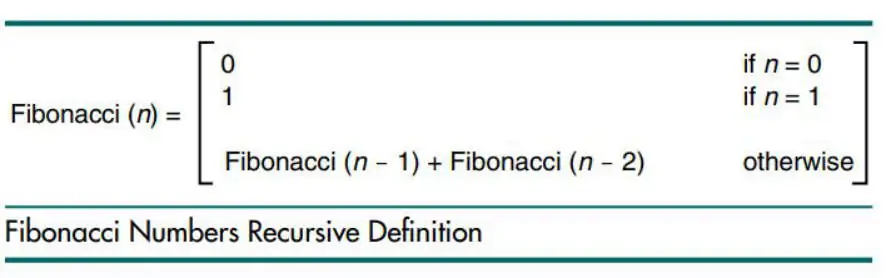
- Fibonacci numbers are named after Leonardo Fibonacci, an Italian mathematician who lived in the early thirteenth century.
- In this series, each number is the sum of the previous two numbers.
The first few Fibonacci series are:
- 0,1,1,2,3,5,8,13,21,34,...
Design
To start a Fibonacci series, we need to know the first
- two numbers.
These are 0 and 1. These are the base cases.
TIME AND SPACE COMPLEXITY OF FIBONACCI SEQUENCE USING RECURSION
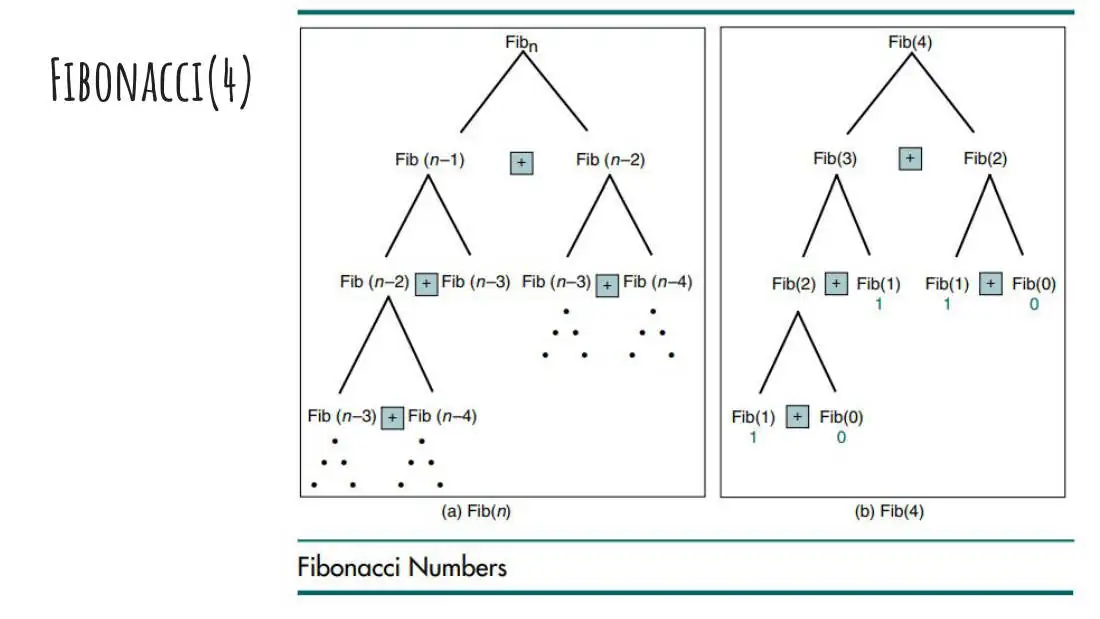
- For fibonacci(n), it calls fibonacci(n-1) and fibonacci(n-2).
- Each of those again makes two recursive calls, and so on.
- This forms a binary recursion tree.
The number of nodes in this tree grows exponentially, approximately 2^n.
So:
Time Complexity = O(2^n) -> Exponential Time (due to redundant computation)
The space complexity comes from the recursive call stack.
- At most, the recursion goes down n levels (from fibonacci(n) to fibonacci(0)).
- So, the maximum depth of recursion = n.
- Each recursive call uses stack memory.
Therefore:
Space Complexity = O(n)
int recursiveFib(int n){ if(n == 0 || n == 1)
return n;
else return recursiveFib(n-1)+ recursiveFib(n-2);
} void printFib(int terms) { for (int i = 0; i < terms; i++) { printf("%d ", recursiveFib(i));
} printf("\n");
}
Greatest common divisor (GCD)
- A common mathematics function is to
determine the GCD for two numbers.
- For example, the greatest common divisor for 10 and 25 is 5
Gcd design
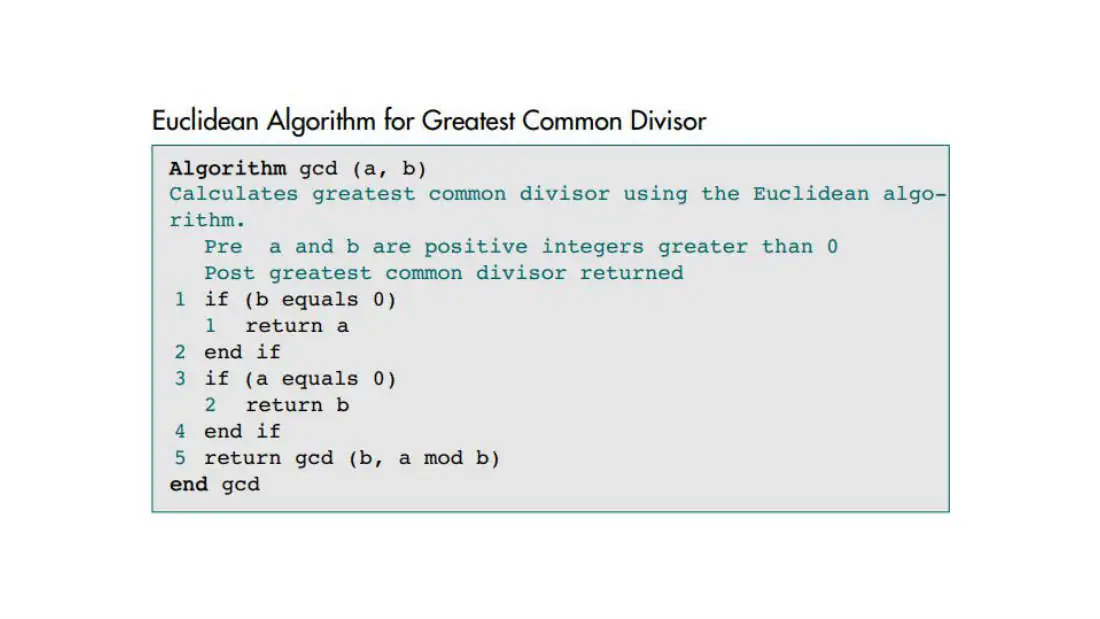
We use the Euclidean algorithm to determine the greatest
- common divisor between two non-negative integers.
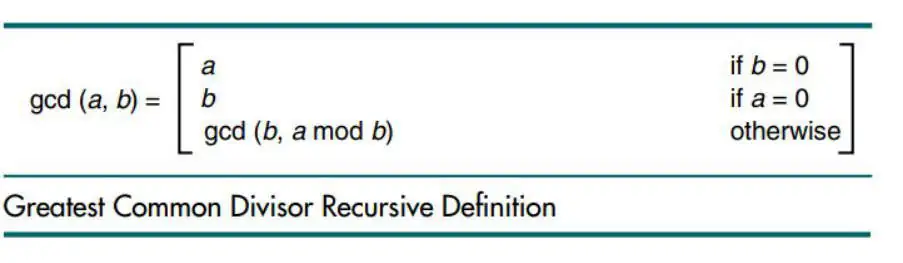
Given two integers, a and b, the greatest common divisor
- is recursively found using the formula.
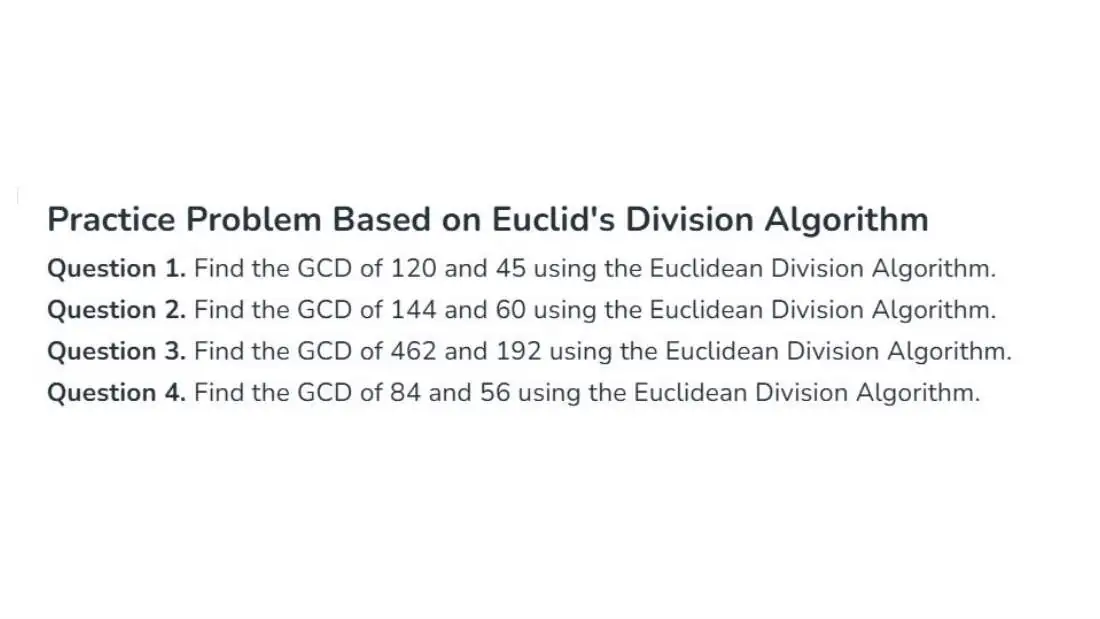
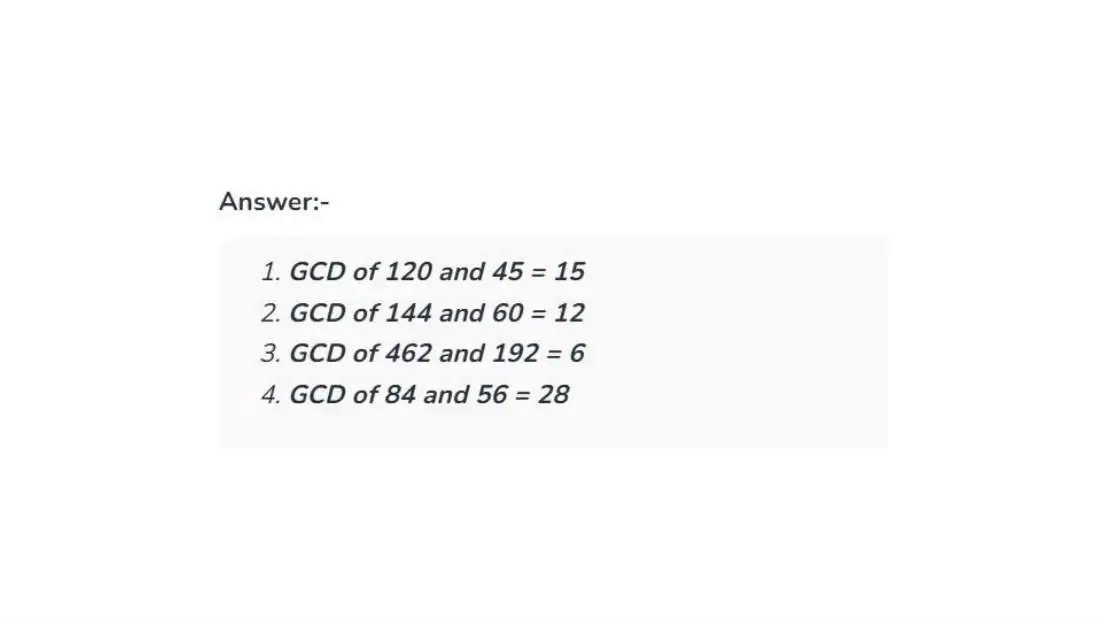
The Euclidean Division Algorithm is a method used in
- mathematics to find the Greatest Common Divisor (GCD) of two numbers.
- It is based on Euclid’s Division Lemma.
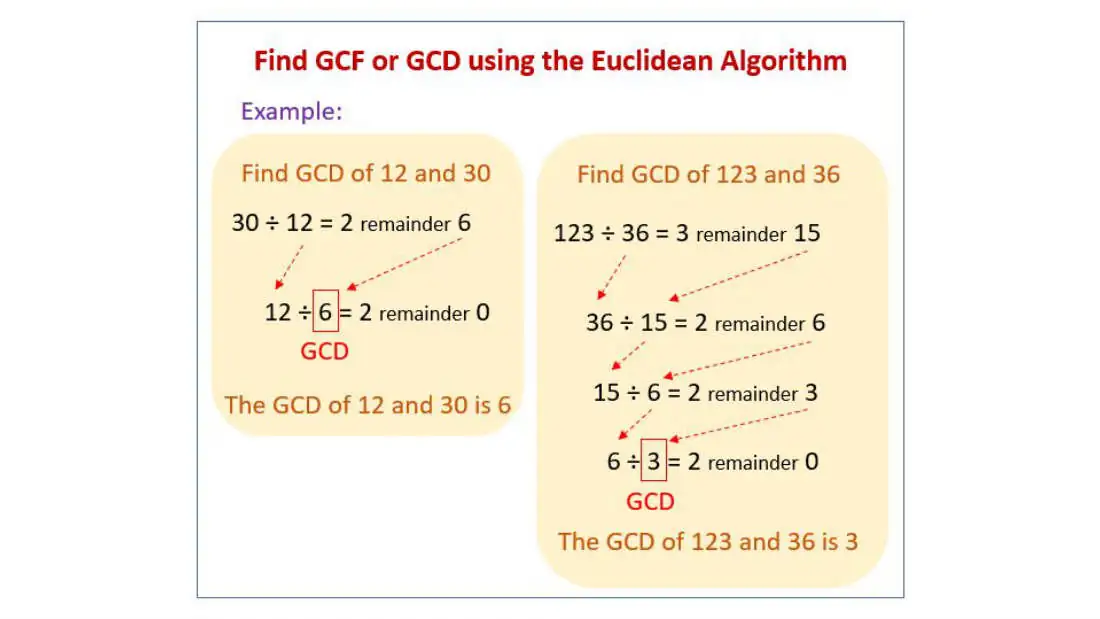
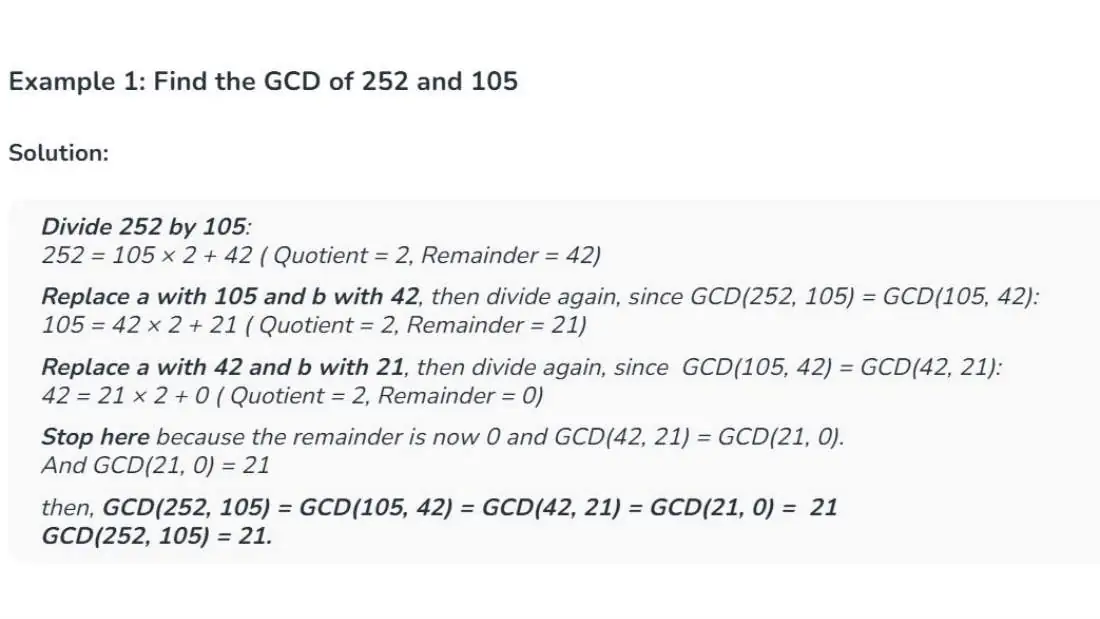
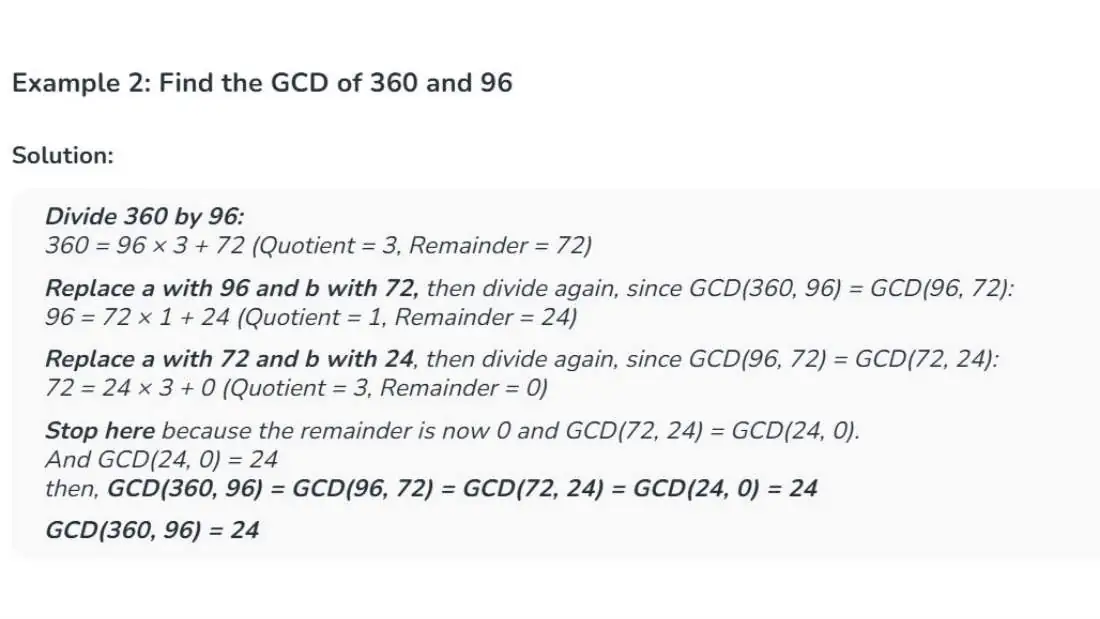
- In this algorithm we repeatedly divide and find remainders until the remainder becomes zero.
- According to Euclidean Division Algorithm, two positive integers a and b, where a = bq + r, a common divisor of a and b is also a common divisor of b and r, and vice versa,
- GCD(a,b) = GCD(b,r)
How many steps does it take? (Time complexity)
Think like this:
- Each step makes the numbers smaller.
- In fact, the remainder gets smaller very quickly.
Example:
From (48, 18) → we went to (18, 12) → then (12, 6) → then (6, 0).
- Just 3 steps and we got the answer!
- Mathematicians proved that the slowest case happens when the numbers are consecutive Fibonacci numbers (like 21 and 34).
Even then, the number of steps is about logarithmic in size of the smaller number
Time Complexity = O(log(min(a,b)))
How many steps does it take? (Time complexity)
Even then, the number of steps is about logarithmic in size of the smaller number
Time Complexity = O(log(min(a,b)))
This means:
If the numbers are small -> very fast
- If the numbers are huge -> still fast, because
- logarithm grows very slowly.
How much memory does it use? (Space complexity)
Two cases:
- Recursive Version
- Every recursive call goes deeper until b = 0.
- Depth = number of steps = O(log(min(a, b))).
- So space = O(log(min(a, b))) (because of stack frames).
- Iterative Version
- We don’t use recursion, just a loop.
- Only a few variables are needed.
- So space = O(1).
Determine whether a string is palindrome
Problem Statement: Given a string, check if the string is palindrome or not. A string is said to be palindrome if the reverse of the string is the same as the string.
Example:
Example 1:
Input Str: “ABCDCBA” Output: Palindrome Example 2:
Input Str: A man, a plan, a canal, Panama Output: Palindrome
Determine whether a string is palindrome
Problem Statement: Given a string, check if the string is palindrome or not. A string is said to be palindrome if the reverse of the string is the same as the string.
Example:
Example 3:
Input Str: Mr. Owl ate my metal worm Output: Palindrome Example 4:
Input Str: Do geese see God?
Output: Palindrome
Determine whether a string is palindrome
Problem Statement: Given a string, check if the string is palindrome or not. A string is said to be palindrome if the reverse of the string is the same as the string.
Example:
Example 5:
Input Str: Was it a car or a cat I saw?
Output: Palindrome Example 6:
Input Str: Do geese see God?
Output: Palindrome
Determine whether a string is palindrome
Problem Statement: Given a string, check if the string is palindrome or not. A string is said to be palindrome if the reverse of the string is the same as the string.
Example:
Example 7:
Input Str: tattarrattat Output: Palindrome Example 8:
Input Str: Malayalam Output: Palindrome
Determine whether a string is palindrome
Problem Statement: Given a string, check if the string is palindrome or not. A string is said to be palindrome if the reverse of the string is the same as the string.
Example:
Example 9:
Input Str: Hi there Output: Not Palindrome Example 8:
Input Str: To be or not to be Output: Not Palindrome
REcursion idea for palindromes
- Instead of reversing the string, we can compare characters from the start and end moving inward.
- Base Case:
- If left index ≥ right index → string is palindrome.
- Recursive Case:
- If characters at left and right are equal → recurse with left+1 and right-1.
- If characters don’t match → not a palindrome.
- Instead of reversing the string, we can compare characters from the start and end moving inward.
- Base Case:
If left index ≥ right index → string is palindrome.
- Recursive Case:
- If characters at left and right are equal → recurse with left+1 and right-1. If characters don’t match → not a palindrome.
- Since your examples also include spaces, punctuation, and case, we need to clean the string first.
Recursive algorithm
- Preprocess the string:
- Convert to lowercase.
- Remove spaces and non-alphanumeric characters.
- Define a recursive function isPalindrome(str, left, right):
- If left >= right → return True.
If str[left] != str[right] → return False.
- Else → call isPalindrome(str, left+1, right-1).
- Return result.
pseudocode
Algorithm RecursivePalindrome(str):
-
Convert str to lowercase
-
Remove all characters that are not alphabets or digits
-
Define function isPalindrome(s, left, right):
if left >= right:
return True if s[left] != s[right]:
return False return isPalindrome(s, left+1, right-1)
-
Call result = isPalindrome(cleanedStr, 0, length(cleanedStr)-1)
-
If result is True:
print "Palindrome" Else:
print "Not Palindrome"
Example walkthrough
Input: "Mr. Owl ate my metal worm"
- Clean string → "mrowlatemymetalworm" Call isPalindrome("mrowlatemymetalworm", 0, 18)
- Compare first and last → m == m
- Compare second and second last → r == r
- Keep recursing until indices cross → Base case reached.
- Returns True → Palindrome.
Palindrome complexity
- Time Complexity
Suppose the cleaned string has length n.
- Each recursive call compares two characters (left and right).
After each step, we reduce the problem size by 2 (move
- inward).
- So total recursive calls ≈ n/2 → O(n) comparisons.
Time Complexity = O(n)
-
Space Complexity Two factors contribute:
-
Recursion Call Stack
- Each recursive call adds a new frame to the stack.
- In the worst case, there are n/2 recursive calls → O(n) stack space.
- Extra Space for Cleaned String
- We also store a cleaned version of the string → O(n) extra space. So overall space complexity:
Space Complexity = O(n)
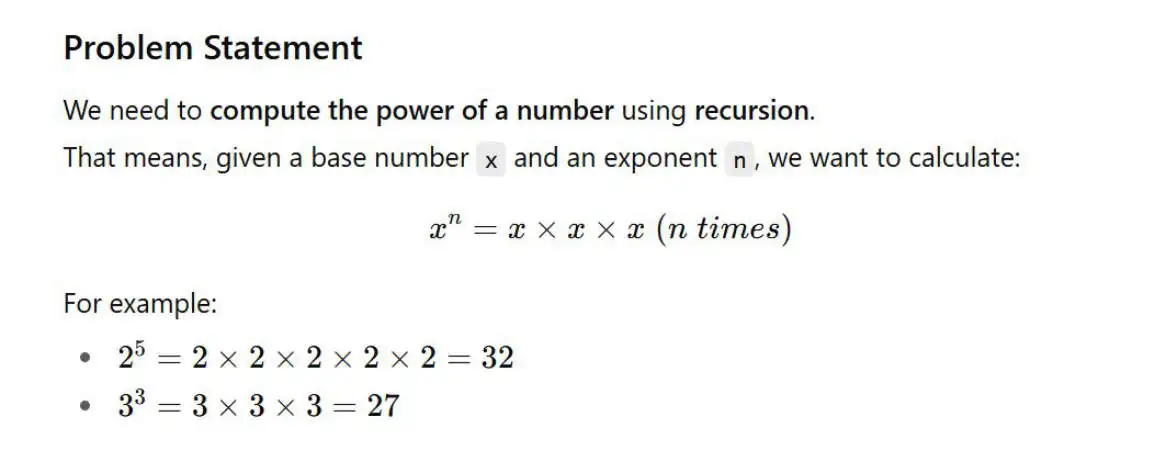
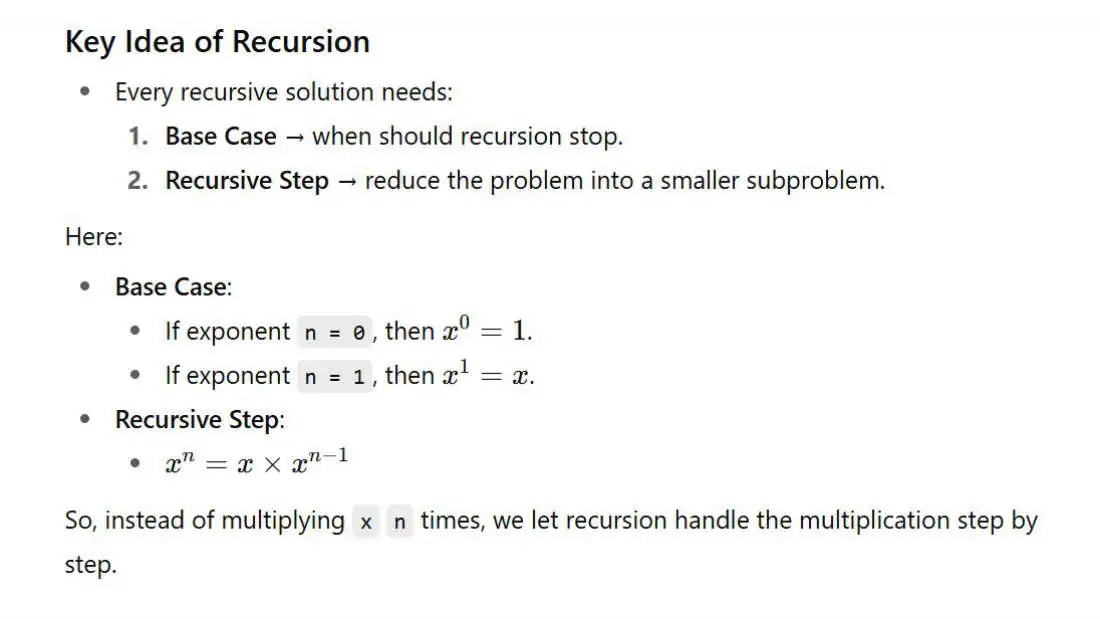
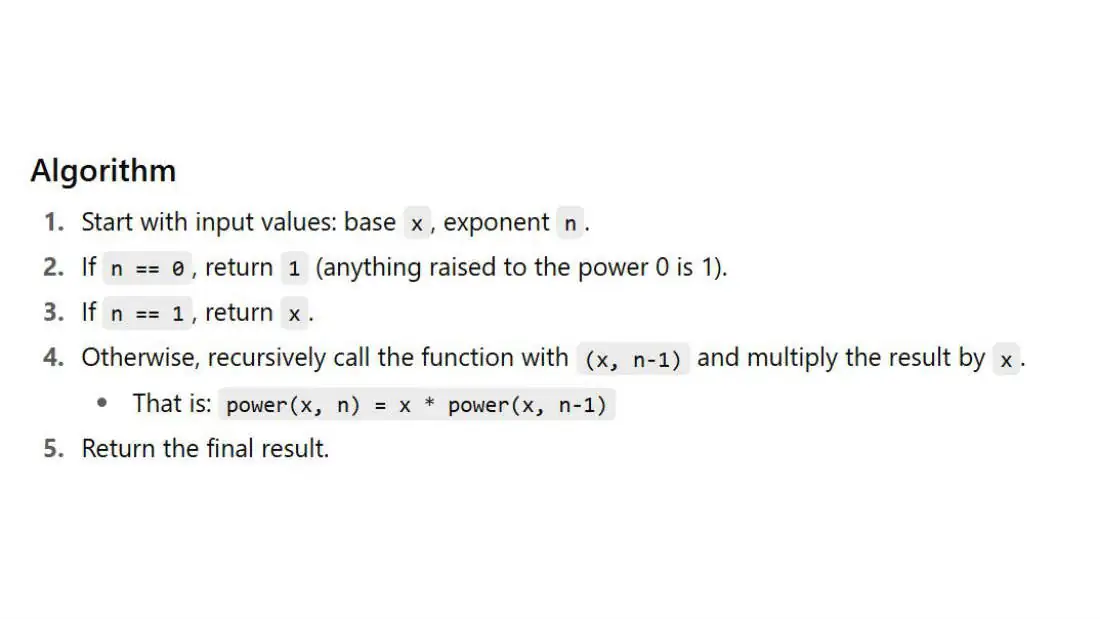
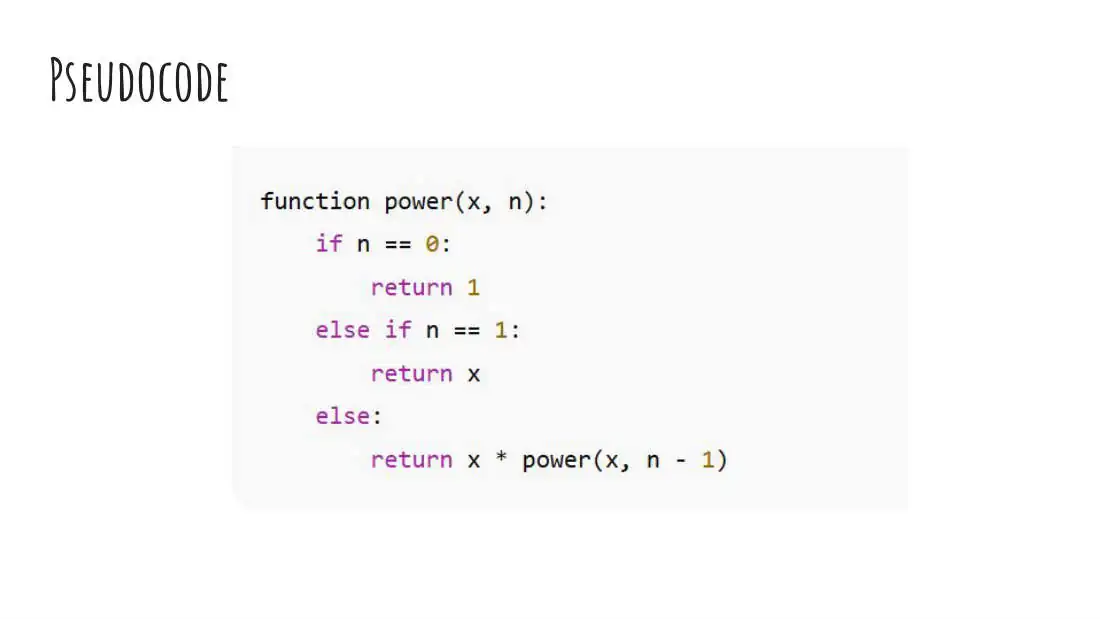
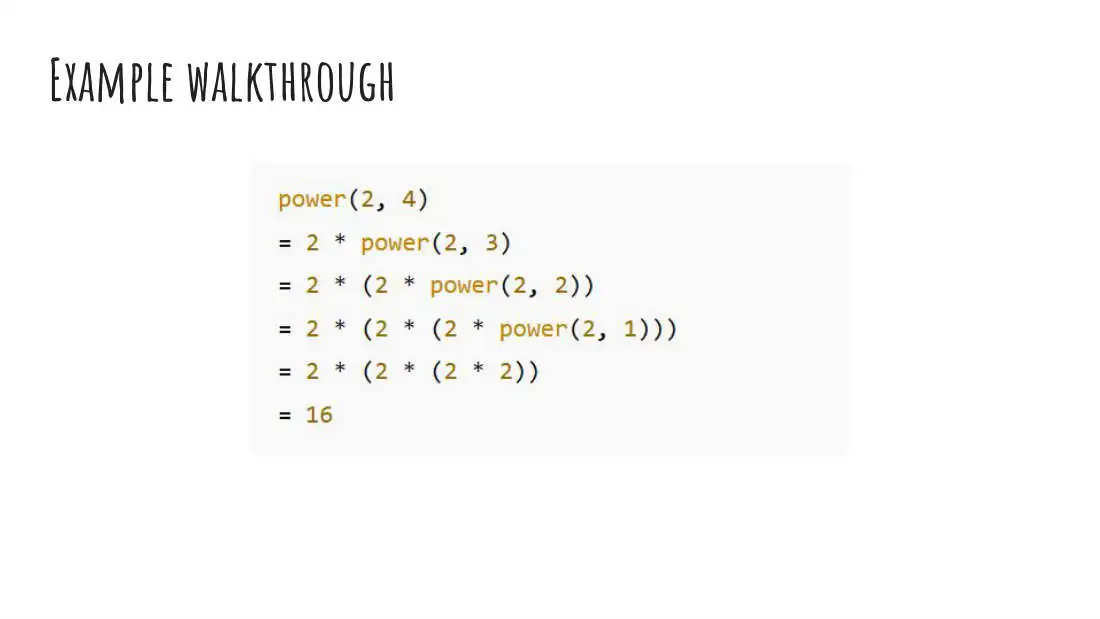
Compute powers of a number using recursion
Towers of hanoi
- The Towers of Hanoi is a classic recursion problem that is relatively easy to follow, is efficient, and uses no complex data structures.
- The Tower of Hanoi puzzle was invented by the French mathematician Edouard Lucas in 1883.
- According to the legend, the monks in a remote mountain monastery knew how to predict when the world would end.
- They had a set of three diamond needles.
- Stacked on the first diamond needle were 64 gold disks of decreasing size.
The monks moved one disk to another needle each hour,
- subject to the following rules:
-
Only one disk could be moved at a time.A larger disk must never be stacked above a smaller one.
-
One and only one auxiliary needle could be used for the intermediate storage of disks.
- The legend said that when all disks had been transferred to the
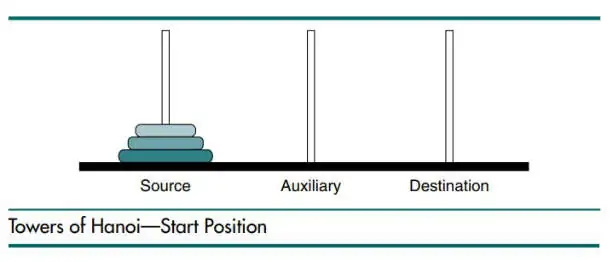
destination needle,the stars would be extinguished and the world would end.
- Today we know that we need to have 264 - 1 moves to move all of the disks
- The problem is interesting for two reasons: The recursive solution is much easier to code than the
- iterative solution would be, as is often the case with good recursive solutions.
Its solution pattern is different from the simple
- examples we have discussed above.
- As you study the towers solution, note that after each base case, we return to a decomposition of the general case for several steps.
- In other words,the problem is divided into several subproblems, each of which terminates with the base case, moving one disk.
Recursive Towers of hanoi design
- To solve this problem, we must study the moves to see if we can find a pattern.
We will use only three disks because we do not
- want the world to end.
- First, imagine we have only one disk to move. This is a very simple case.
- Case 1: Move one disk from source to destination needle
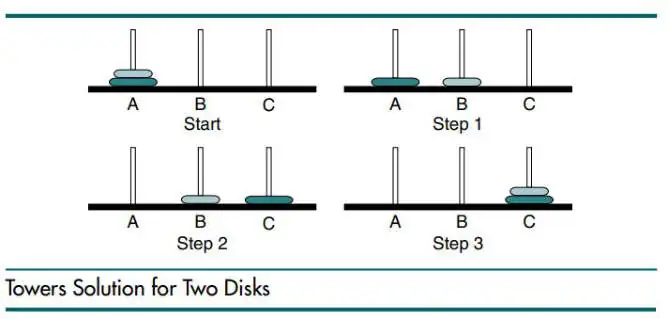
- Now imagine that we have to move two disks.
- First we move the top disk to the auxiliary needle. Then we move the second disk to the destination needle. Finally we move the first disk to the top of the second disk on the destination needle.
- Case 2:
- Move one disk to the auxiliary needle
- Move one disk to the destination needle
- Move one disk from the auxiliary to destination needle
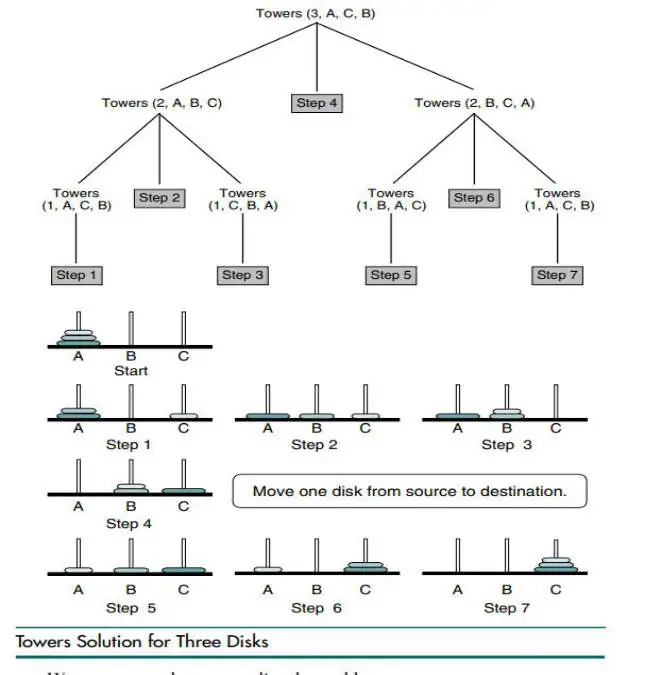
- The case for three disks.
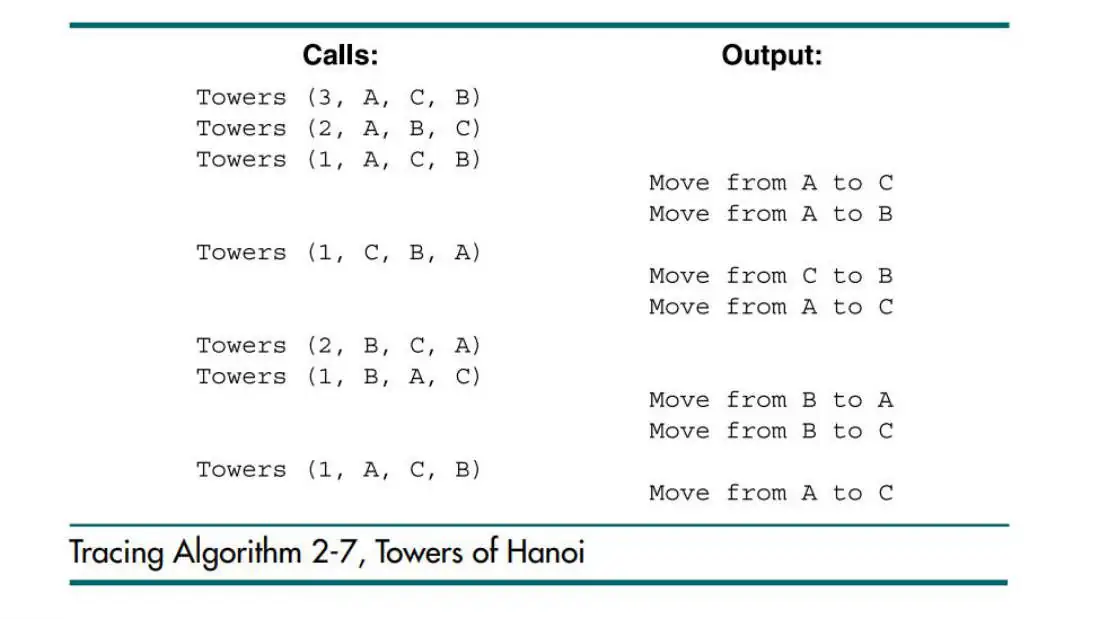
- The first three steps move the top two disks from the source to auxiliary needle (Refer Case 2)
- In Step 4 we move the bottom disk to the destination needle.
- We now have one disk in place. This is example of Case 1.
We then need three more
- steps to move the two disks on the auxiliary needle to the destination needle.
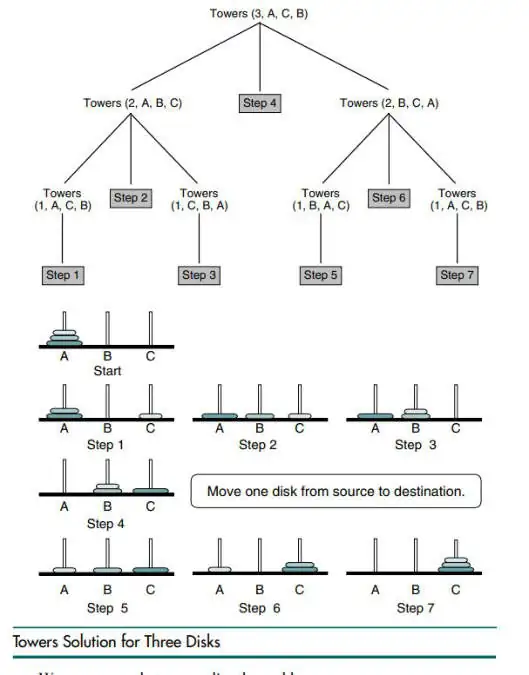
- The case for three disks.
Case 3:
-
Move two disks from source to auxiliary needle
-
Move one disk from source to destination needle
-
Move two disks from auxiliary to destination needle
We are now ready to generalize the problem.
-
Move n-1 disks from source to auxiliary, using destination.
-
Move one disk from source to destination. Base Case
-
Move n-1 disks from auxiliary to destination, using source General Case
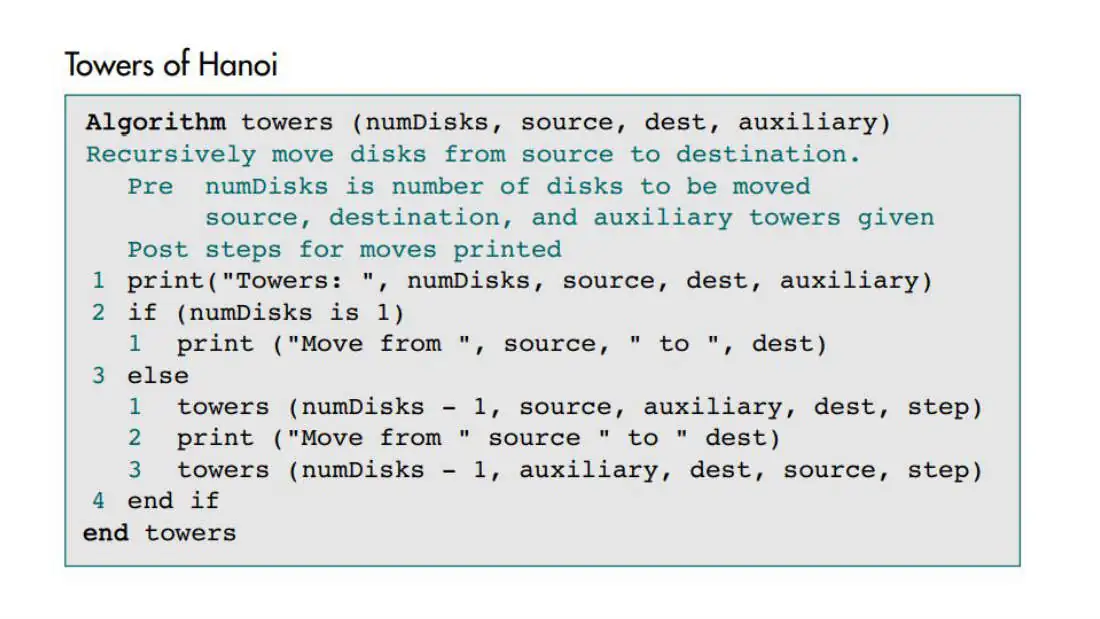
- Our solution requires an algorithm with four parameters
- The number of disks to be moved The source needle
- The destination needle
- The auxiliary needle
- Using pseudocode the three moves in the generalization shown above are then:
-
Call Towers(n-1, source, auxiliary, destination)
-
Move one disk from source to destination
-
Call Towers(n-1, auxiliary, destination, source)
- Study the second call above carefully After we complete the move of the first disk, the
- remaining disks are on the auxiliary needle.
- We need to move them from auxiliary needle to destination needle.
- In this case the original source needle becomes the auxiliary needle.
(Remember that the positions of the parameters in the called algorithm are source, destination, and auxiliary. The calling algorithm must remember which of the three needles is the source and which is the destination for each call.)
THe Josephus Problem
What is the Josephus Problem?
The Josephus Problem is a famous puzzle in mathematics and computer science.
It goes like this:
- Imagine n people standing in a circle
- You start counting them, one-by-one, around the circle.
- Every kth-person is eliminated (removed) from the circle.
- The counting continues from the next person after the one who was eliminated.
This keeps going until one person remains.
The problem asks:
If you know n (the total people) and k (the step), which position should you stand in to be the last survivor?
A simple example
Let’s take n = 5 people standing in a circle:
Number them: 1, 2, 3, 4, 5
Suppose k = 2, meaning every 2nd person is removed.
Step by step elimination:
Start at 1 → count 2 → person 2 is eliminated.
-
Remaining: 1, 3, 4, 5
-
Next count starts at 3 → count 2 → person 4 is eliminated. Remaining: 1, 3, 5
-
Start at 5 → count 2 → person 1 is eliminated.
Remaining: 3, 5
- Start at 3 → count 2 → person 5 is eliminated.
Remaining: 3
So, if you were standing at position 3, you would survive!
Why is it interesting?
- At first, it looks like a simple game of counting, but the elimination keeps shifting in a tricky way.
- It’s a great problem for understanding recursion (a way a function can call itself).
- It is also useful in computer science (like memory management, circular queues, or resource allocation problems).
The problem has the following recursive structure.
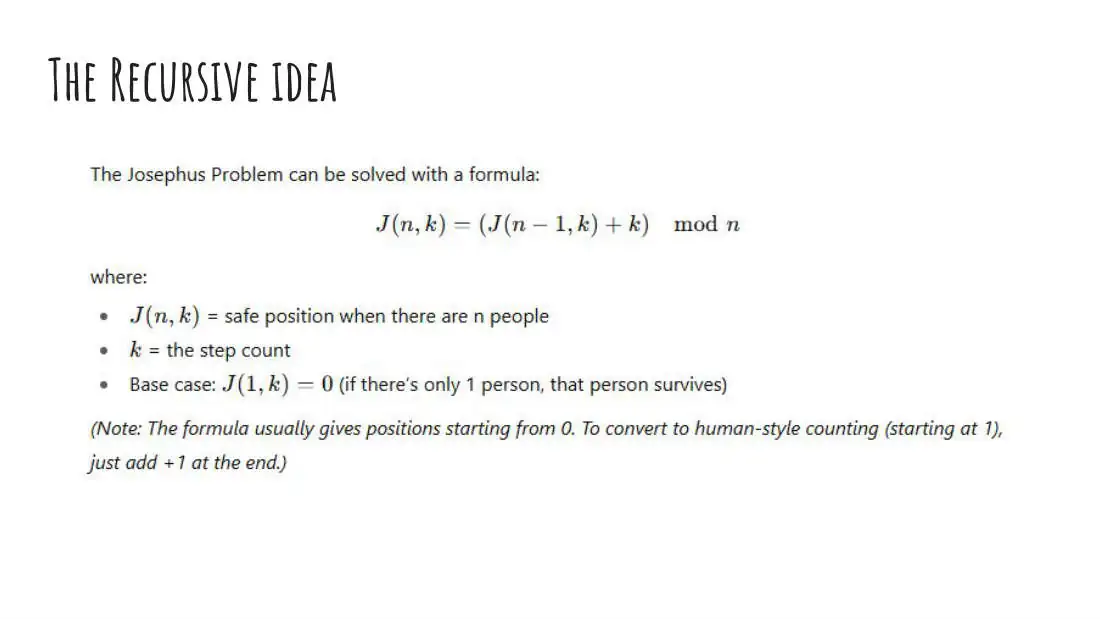
josephus(n,k) = (josephus(n-1),k) % n + 1 and josephus(1,k) = 1 After the first person (kth from the beginning is killed), n - 1 persons are left.
Make recursive call for josephus(n-1,k) to get the position with n - 1 persons. But the position returned by josephus (n-1,k) will consider the position starting from k % n + 1. So make adjustments to the position returned by josephus(n-1,k)
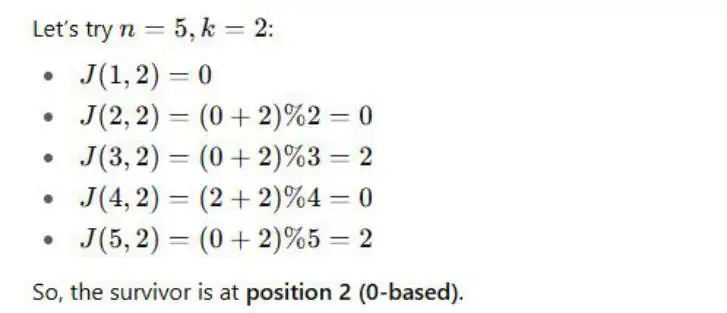
In human counting (1-based), that’s position 3- which matches our step-by-step elimination earlier.
Summary
The Josephus Problem is about finding the safest spot in
- a counting elimination game.
It can be solved step-by-step OR with a neat recursive
- formula.
- It’s a classic problem in algorithms and teaches you about recursion and modular arithmetic.
summary
There are two approaches to writing repetitive algorithms
- : iteration and recursion Recursion is a repetitive process in which an algorithm
- calls itself.
- A repetitive algorithm uses recursion whenever the algorithm appears within the definition itself.
- When a program calls a subroutine, the current module suspends processing and the called subroutine takes over the control of the program. When the subroutine completes its processing and returns to the module that called it, the module wakes up and continues its processing.
- In a recursive algorithm, each call either solves part of the problem or reduces the size of the problem.
- The statement that solves the problem is known as the base case; every recursive algorithm must have a base case.
- The rest of the recursive algorithm is known as the general case.
The general rule for designing a recursive algorithm is as
- follows:
-
Determine the base case
-
Determine the general case
-
Combine the base case and the general case into an algorithm
exercises
- Consider the following algorithm
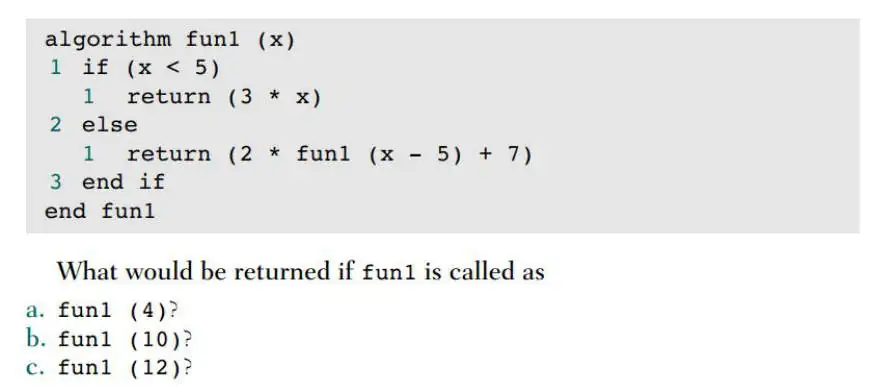
Solution:
fun1(4)
Here x = 4.
Since 4 < 5, we use the base case: fun1(4) = 3 * 4 = 12
Therefore fun1(4) = 12
Solution:
fun1(10)
Here x = 10.
Step 1 10 >= 5 fun1(10) = 2 * fun1(10 - 5) + 7 fun1(5) = 2 * fun1(5 - 5) + 7 Now compute fun1(0) = 3 * 0 ( since 0 < 5) Substitute back:
fun1(5) = 2 * 0 + 7 = 7 fun1(10) = 2 * 7 + 7 = 21
Solution:
fun1(12)
Here x = 12.
Step 1 12 >= 5 fun1(12) = 2 * fun1(12 - 5) + 7 fun1(7) = 2 * fun1(7 - 5) + 7
Now compute fun1(2) = 3 * 2 ( since 2 < 5) = 6 Substitute back:
fun1(7) = 2 * 6 + 7 = 19 fun1(12) = 2 * 19 + 7 = 45
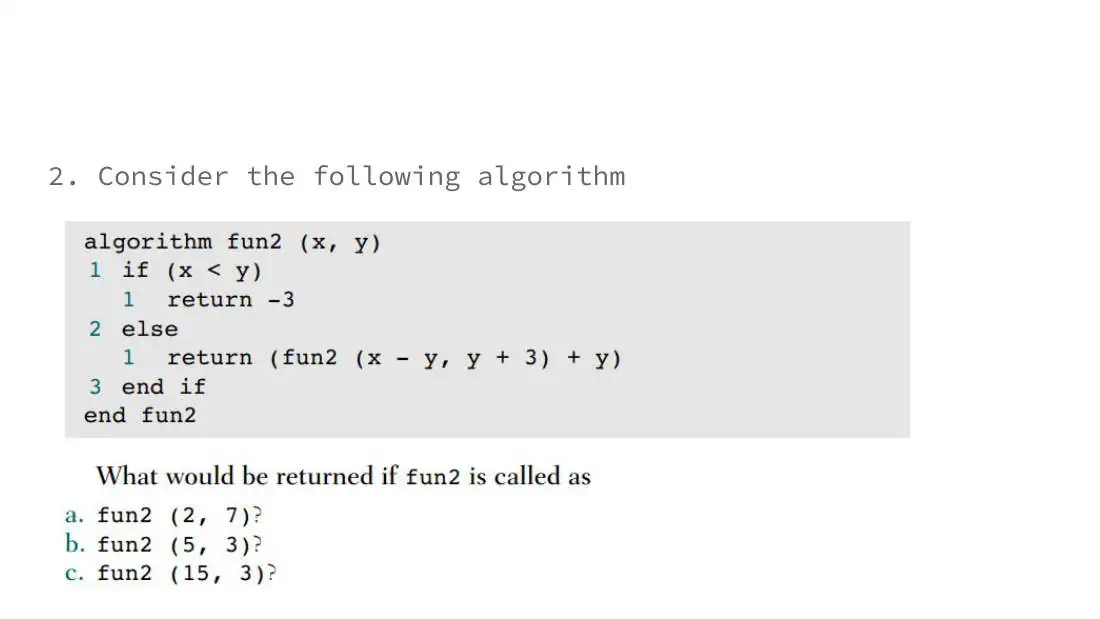
Solution
-
fun2(2,7) = -3
-
fun2(5,3) = 0
-
fun2(15,3) = 6
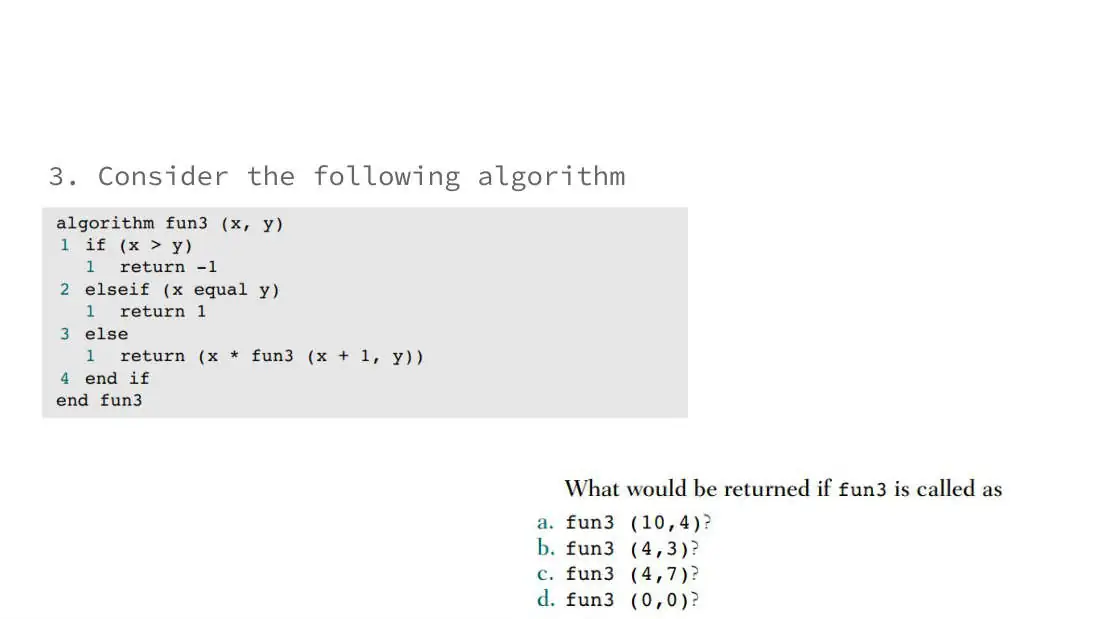
Solution:
-
fun3(10,4) = -1
-
fun3(4,3) = -1
-
fun3(4,7) = 120
-
fun3(0,0) = 1
-
Write a recursive algorithm that calculates and returns the length of a list.
-
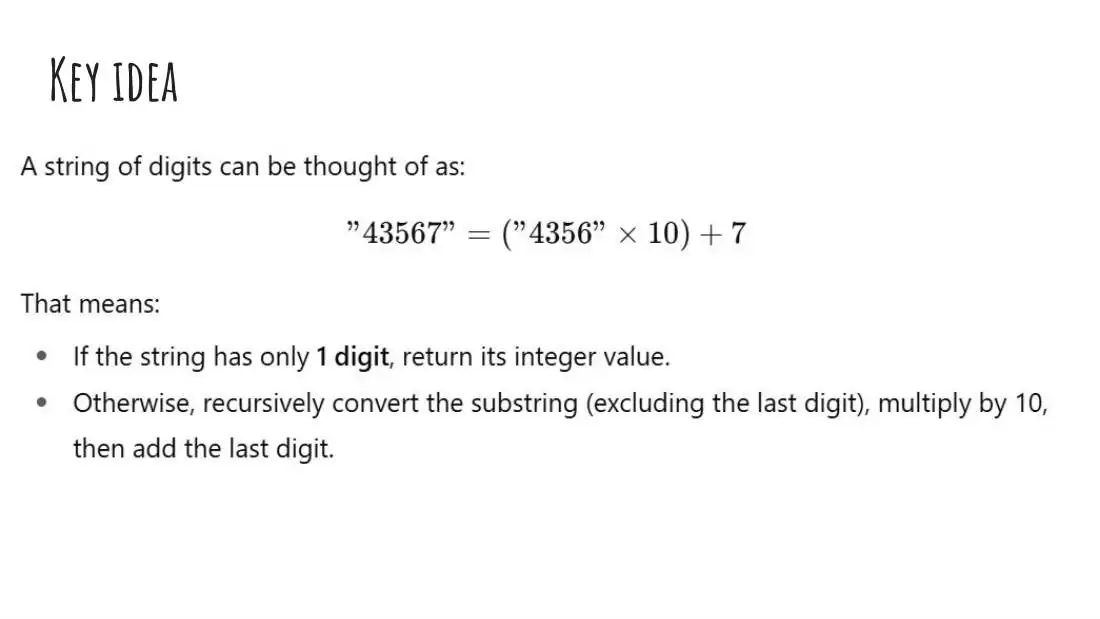
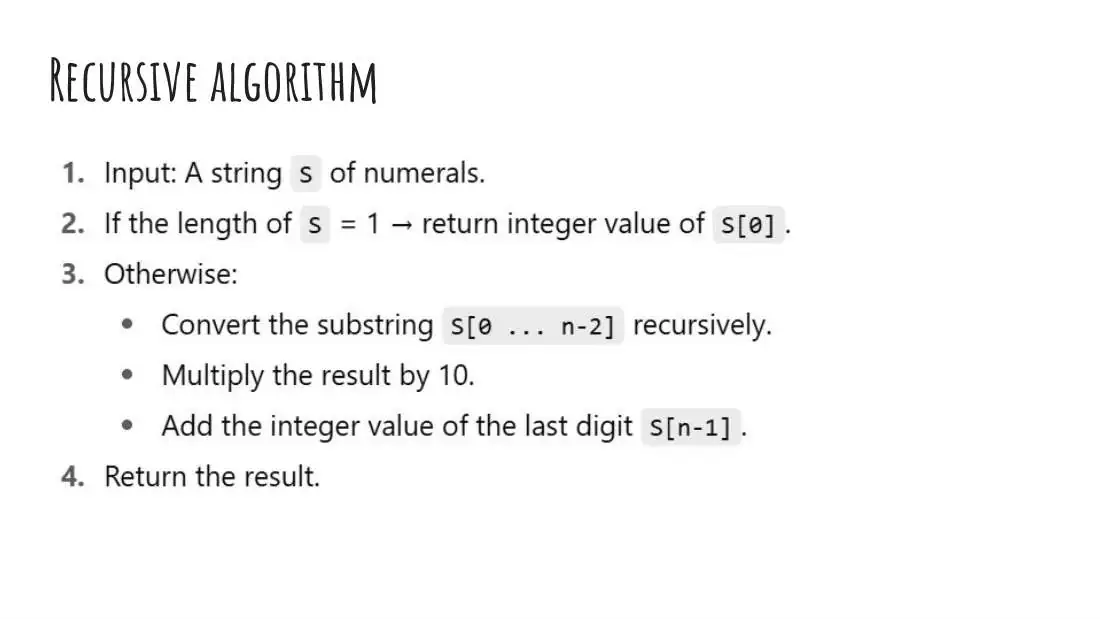
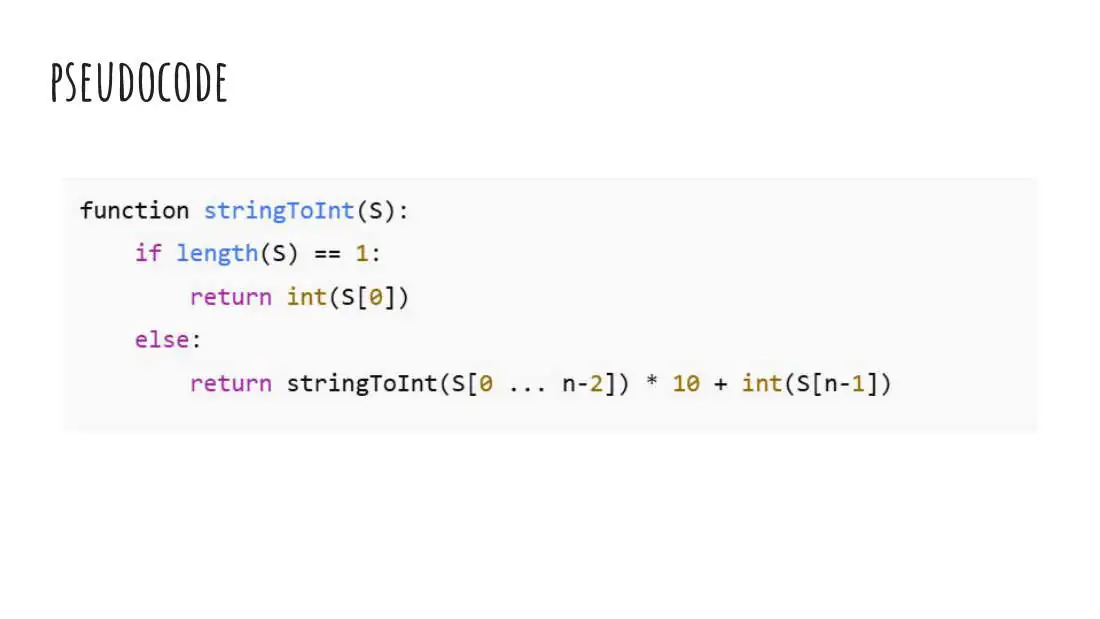
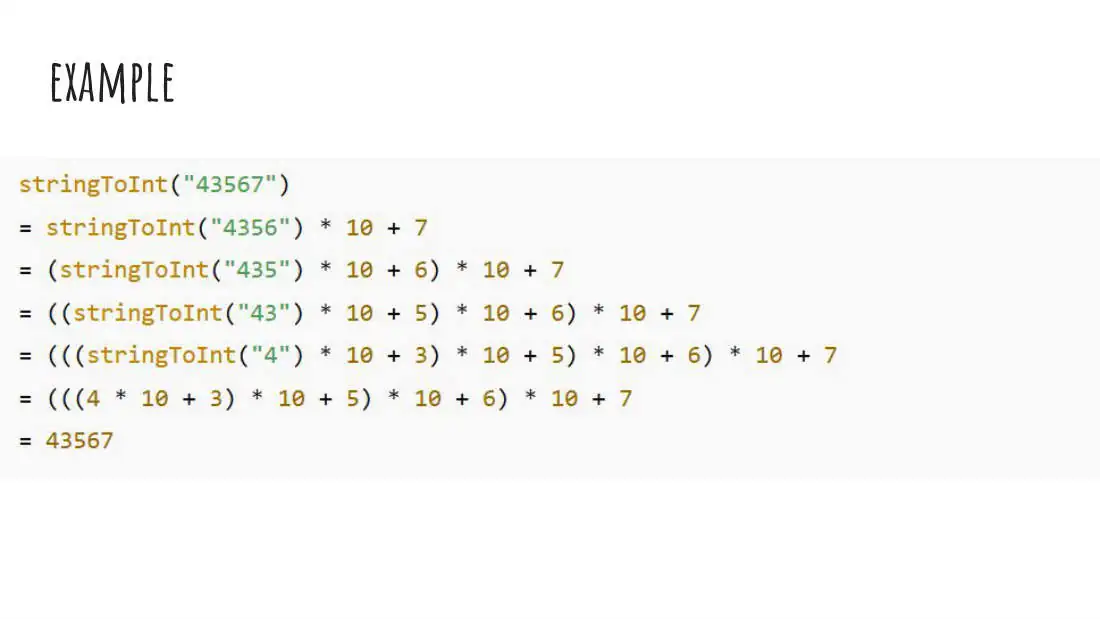
Write a recursive algorithm that converts a string of numerals to an integer. For example, “43567” will be converted to 43567.
-
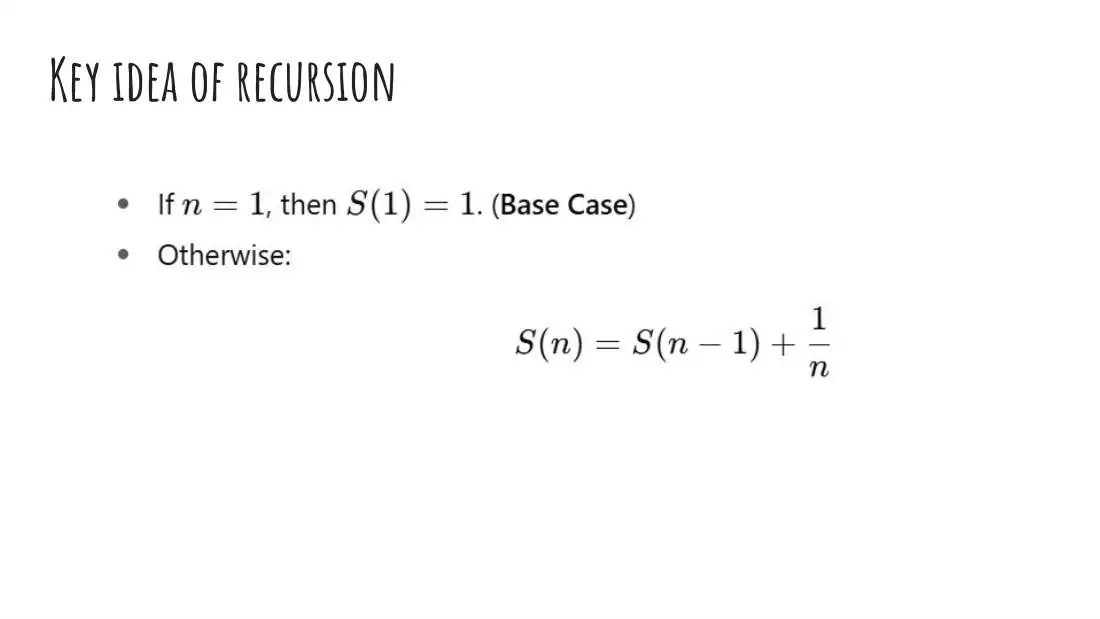
Write a recursive algorithm to add the first n elements of the series.
1 + 1/2 + 1/3 + 1/4 + 1/5 +...+1/n
Recursive algorithm that calculates and returns length of a list
Key Idea of Recursion
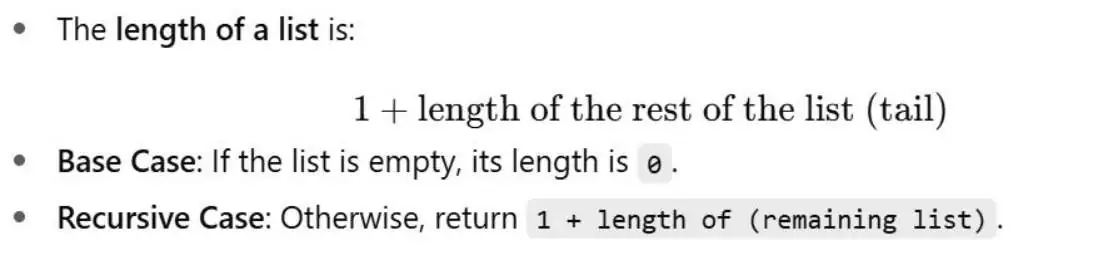
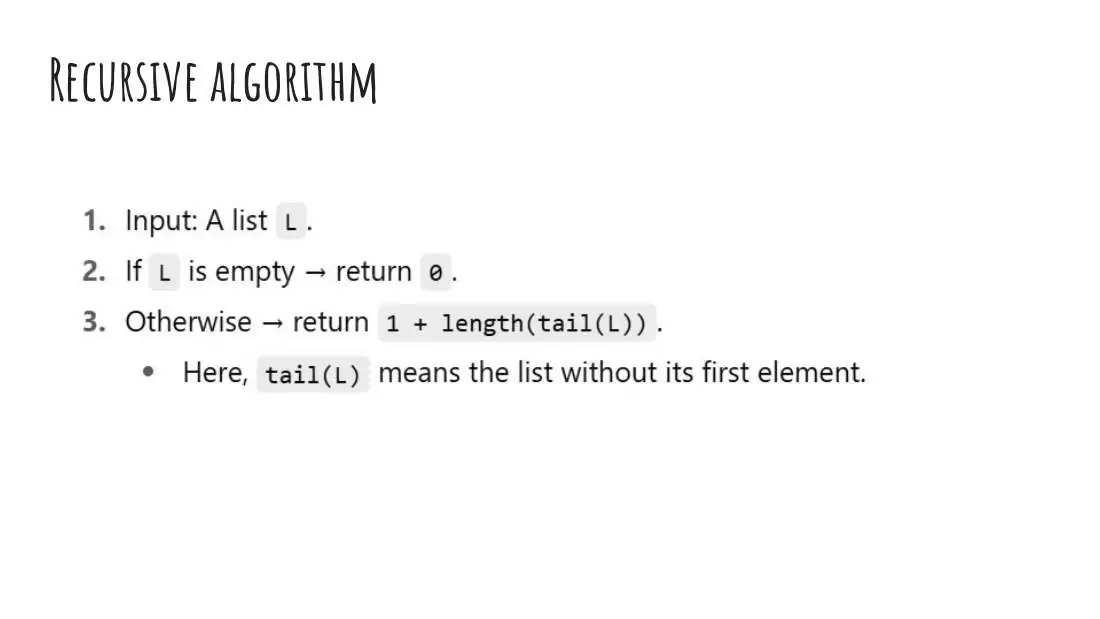
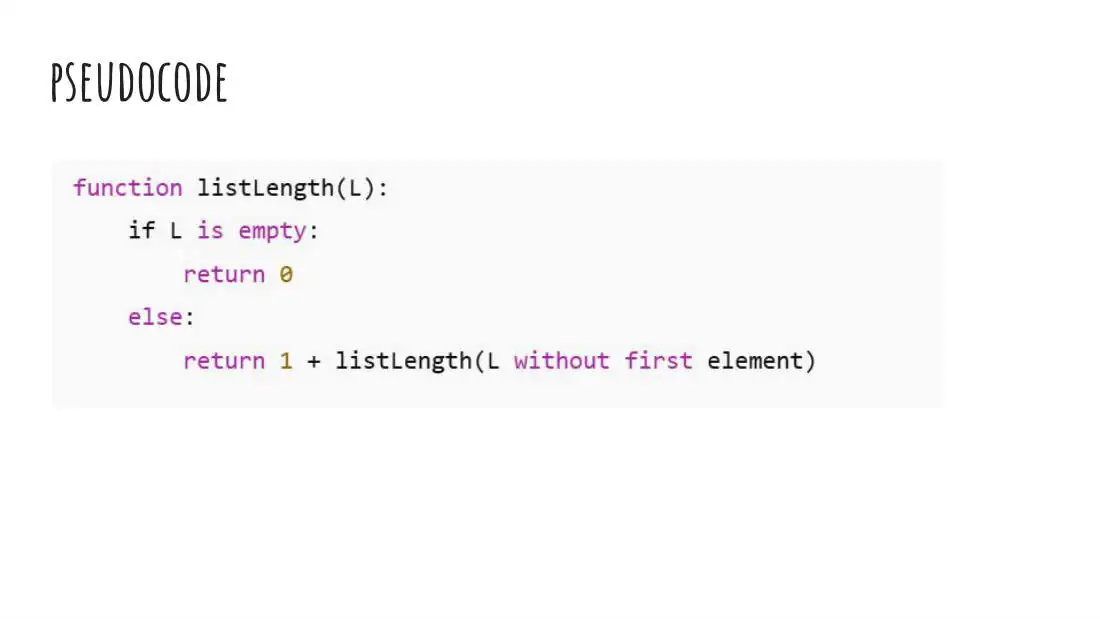
example
Suppose L = [10, 20, 30]
listLength([10,20,30])
= 1 + listLength([20,30])
= 1 + (1 + listLength([30]))
= 1 + (1 + (1 + listLength([])))
= 1 + (1 + (1 + 0))
= 3
So the length is 3
Recursive algorithm that converts a string of numerals to an integer
Write a recursive algorithm that converts a string of numerals to an integer. For example, “43567” will be converted to 43567.
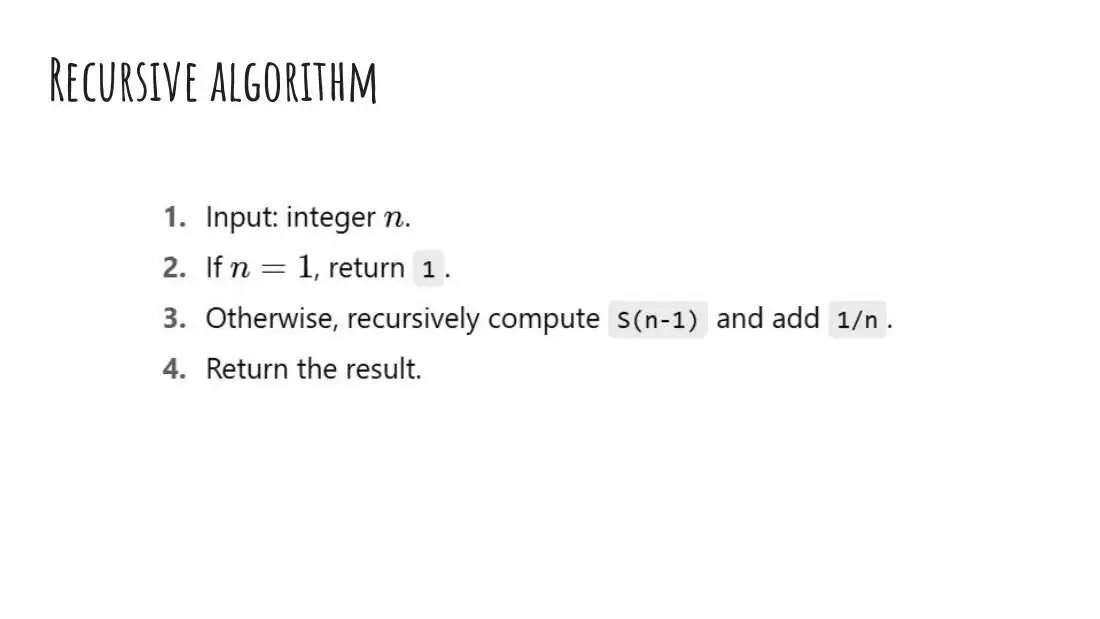
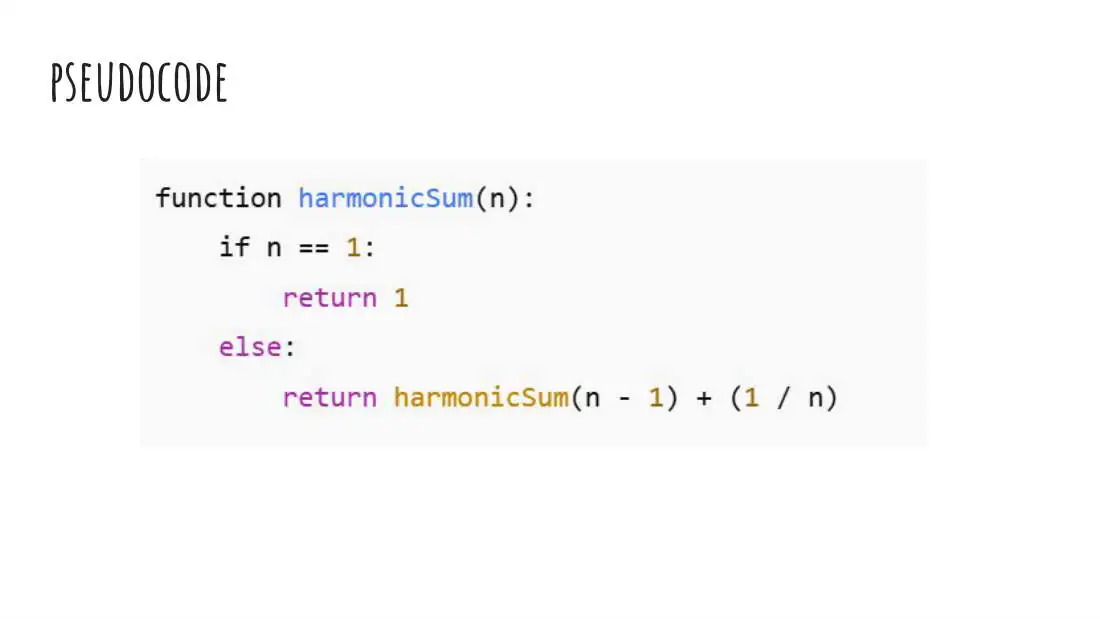
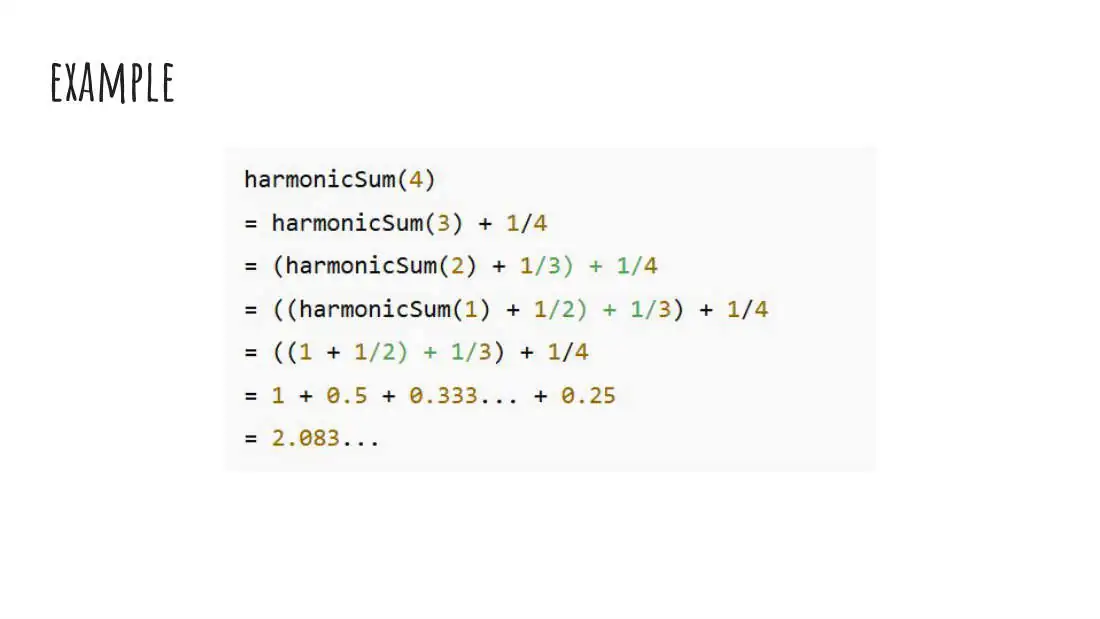
Recursive algorithm to add the first n elements of the series
Write a recursive algorithm to add the first n elements of the series. (Harmonic Series)
S(n) = 1 + 1/2 + 1/3 + 1/4 + 1/5 +...+1/n
Prefix to postfix conversion
An arithmetic expression can be
- represented in three different formats:
- Infix
- Prefix
- Postfix
- In an infix notation, the operator comes between the two operands, the basic format of the algebraic notation.
- In postfix notation, the operator comes after its two operands.
- In prefix notation, the operator comes before its two operands.
Although some high-level languages use the infix and
- postfix notations, these expressions cannot be directly evaluated.
They must be analyzed to determine the order in which the
- expressions are to be evaluated.
One method to analyze them is to use recursion.
design
Convert prefix to postfix format
- Basic concepts:
- Given the prefix expression: *AB, we convert it by moving
- the operator (*) after the operands (A and B).
The postfix format is : AB*
- To keep the algorithm as simple as possible,we assume
- that each operand is only one character and that there are only four operators: add(+), subtract (-), multiply(*) and divide (/)
- To convert a prefix expression we must find its operator and move it after the operands.
- By definition, the operator is always the first character in the prefix string. Following the operator are its two operands.
As the expression grows in complexity,however, we can
- have multiple operators and operands in an expression.
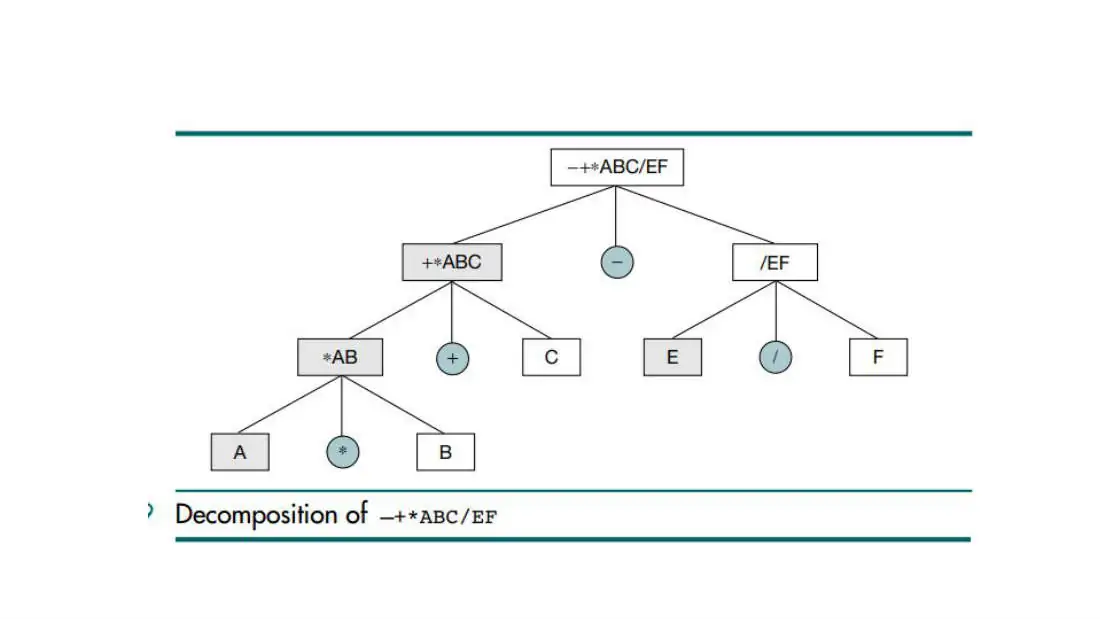
- For example:-+*ABC/EF
- This expression consists of several binary expressions combined into one complex expression.
- To parse it we begin at the left and work right until we isolate one binary expression, in this case *AB.
- Once we have a simple prefix expression, we can convert it to postfix and put it in the output.
The first step in designing a recursive algorithm is
- determining the base case. What is the base case?
- The base case turns out to be finding an operand- in our example, any of the alphabetic characters.
- Because the operand can contain another expression, the general case is to find the operator and the left and right operands in the binary expression.
- We then concatenate them into one postfix expression.
To find the left and right operands in the prefix
- expression, we need a second algorithm that determines the length of a prefix expression.
- The length of an expression is the length of the first sub-expression plus the length of the second expression plus 1 for the operator.
- We also can use recursion for this algorithm.
- Because each operand is one character long, our base case is finding one operand.
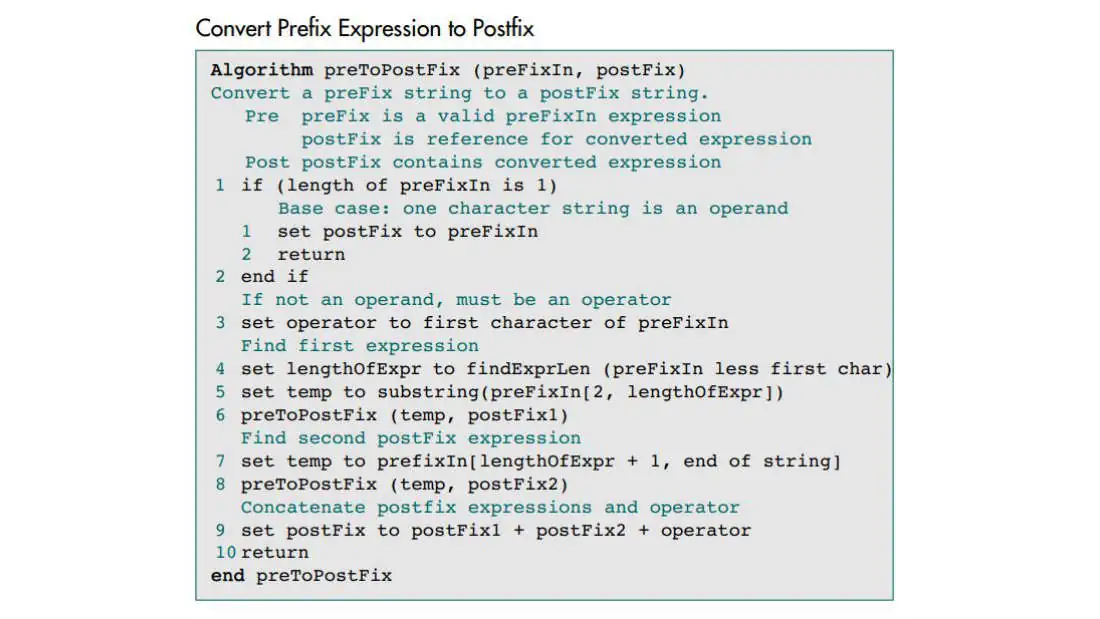
The algorithm is rather straightforward.
- The most difficult part is finding the prefix expression.
- We find it by determining its length and then storing it in a temporary string.
- The notation in statement 5 indicates that the substring starting at the first location and through the second location is to be assigned to temp.
- Once we have identified a prefix expression,we recursively called the algorithm to convert it to postfix.
- Now let’s look at the algorithm that determines the length of the prefix expression.
This algorithm needs to return the length of the
- expression.
- Once again the base case is finding an operand.
- From the definition of the problem, we know that each operand is one character long.
- The minimum length of a prefix expression is therefore three: one for the operator and one for each operand.
- As we recursively decompose the expression,we continue to add the size of its combined expression until we have the total length.
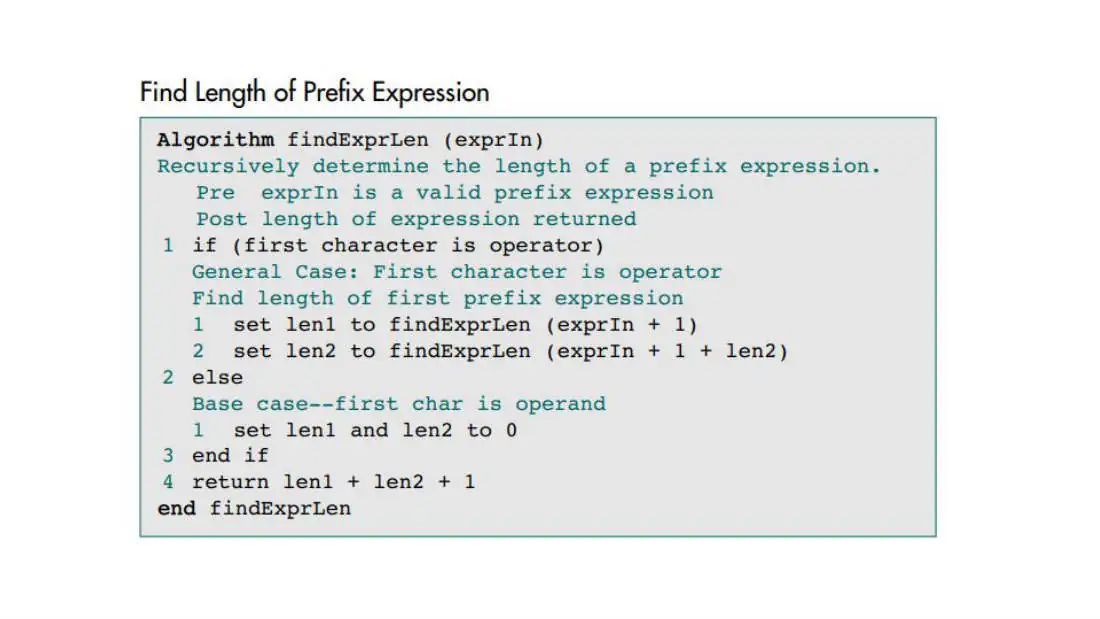
We examine the first character of a string containing a
- prefix expression or a substring.
If it is an operator, we recursively add the length of
- its two operands.
The algorithm returns 1 (the base case) or the length of
- an expression in the prefix expression.